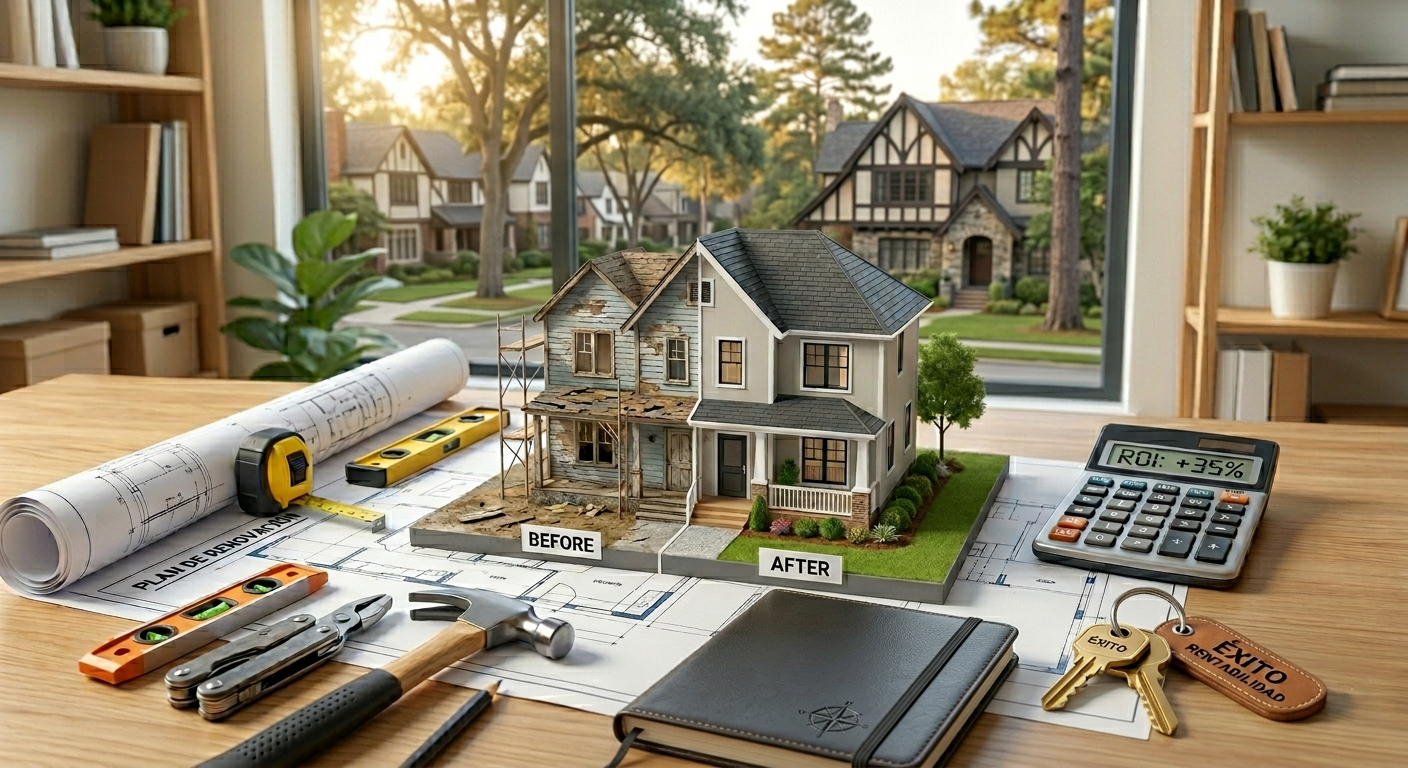
Investing in properties for renovation and resale can be a highly profitable strategy when properly analyzed from the outset. In this type of investment, simply finding an affordable property or one with visual appeal isn't enough. The key lies in making a sound purchase, accurately calculating renovation costs, correctly estimating resale value, and confirming that, after all expenses, an attractive profit remains.
Below, I share a practical guide to help you evaluate these types of opportunities more clearly.
1. Define the investment objective
Before buying, you should be clear that this model consists of buying a property below its potential, strategically renovating it, and selling it at a higher price to generate a profit.
The main question is not whether the property can be fixed, but whether it is really worth fixing from a financial point of view.
2. Calculate the ARV or estimated value after repair
One of the most important concepts in this type of investment is the ARV (After Repair Value), which represents the estimated value of the property once it is rehabilitated and ready to be sold.
Formula:
ARV = estimated selling price of renovated comparable properties
To calculate it correctly, you should analyze recent sales of similar properties in the same area, with similar characteristics and already remodeled. This value will be the basis of almost your entire analysis.
3. Estimate the total cost of rehabilitation
Here you need to calculate how much it will cost to get the property ready for sale. This budget should include all the necessary improvements to ensure the property is competitive in the market.
It includes items such as:
- cleaning and demolition
- interior and exterior painting
- kitchen
- bathrooms
- floors
- doors and windows
- plumbing
- electricity
- roof or waterproofing
- facade and exterior
- permissions, if applicable
Formula:
Total rehabilitation cost = sum of all improvements + contingency
It is advisable to add a contingency for unforeseen events, since these types of projects are rarely executed exactly as initially budgeted.
4. Calculate the total cost of the project
Many investors focus solely on purchase and renovation, but that's not enough. You also need to include closing costs, maintenance, financing, and selling costs.
Formula:
Total project cost = purchase price + rehabilitation + closure costs + maintenance costs + financing costs + sales costs
That number represents the actual cost that you should compare against the estimated resale value.
5. Calculate the projected profit
Here you'll find out if the project really makes financial sense.
Formula:
Projected profit = estimated selling price – total project cost
The more conservative you are with this calculation, the more realistic your analysis will be. In this type of investment, it's better to be pleasantly surprised than to build the trade on overly optimistic expectations.
6. Calculate the profit margin
It's not enough to know how much money you could earn in absolute terms. You also need to assess whether that profit margin compensates for the risk, time, and capital invested.
Formula:
Profit margin = net profit ÷ selling price × 100
This indicator helps you determine if the project justifies the effort and exposure to risk.
7. Use the 70% rule as an initial reference
Many investors use the 70% rule as a quick formula to estimate how much they should pay for a property before starting negotiations.
Formula:
Maximum offer = (ARV × 70%) – rehabilitation cost
This rule is not absolute, but it is a very useful reference to avoid overpaying and compromising the profit margin from the start.
8. Analyze the project timeline
In this type of investment, time is money. The longer you take to renovate and sell, the greater the impact of interest, insurance, utilities, taxes, and other maintenance expenses.
Formula:
Monthly retention cost = mortgage/interest + insurance + utilities + contributions + maintenance
Therefore, in addition to calculating the work, you must evaluate the realistic duration of the project and the cost of maintaining the property during that period.
9. Evaluate the return on invested cash
In addition to the total profit, it is worth measuring what return you will get on the money you actually put in from your own pocket.
Formula:
ROI = net profit ÷ cash invested × 100
This calculation helps you compare this investment with other opportunities and decide if the expected return justifies the capital committed.
10. Identify the errors that most affect profitability
Investments to renovate and sell properties often fail for several recurring reasons. Among the most common are:
- very expensive to buy
- overestimate the resale price
- underestimating the cost of rehabilitation
- ignore hidden costs
- not considering the cost of time
- Make improvements that the market doesn't pay for.
- not leaving enough room for unforeseen events
The more disciplined you are with these points, the more likely you are to close profitable deals.
11. Do a quick assessment before committing
Before buying, it's a good idea to do a simple but effective final check.
Practical formula:
ARV – total project cost = sufficient profit
Then you should ask yourself:
- Does the profit outweigh the risk?
- Do I have enough leeway if the project is delayed?
- What happens if I sell for less than expected?
- What if rehabilitation costs more?
A good opportunity should continue to work even under a conservative scenario.
Final reflection
Investing in properties to renovate and resell can be an excellent strategy, but it shouldn't be approached emotionally, but rather with numbers. The best opportunity isn't necessarily the cheapest or most dilapidated property, but rather the one whose purchase, renovation, and resale yield a healthy profit after considering all costs and risks.
In this type of investment, the real business is built from the initial analysis. If you buy well, calculate accurately, and execute with discipline, a property to renovate can become a very profitable opportunity. But if the numbers aren't solid from the start, the wisest course of action is almost always to pass.
Disclosure / Important Notice:
This publication is for informational and educational purposes only. It does not constitute legal, tax, financial, mortgage, accounting, or investment advice, nor is it a substitute for guidance from licensed professionals. Every real estate transaction involves unique considerations that may vary depending on the property, the market, financing, and individual circumstances. Before making any decisions related to buying, selling, renting, or investing in real estate, you should consult with the appropriate professionals. The information presented is subject to change without notice and does not guarantee future results.








 EN
EN  ES_PR
ES_PR